
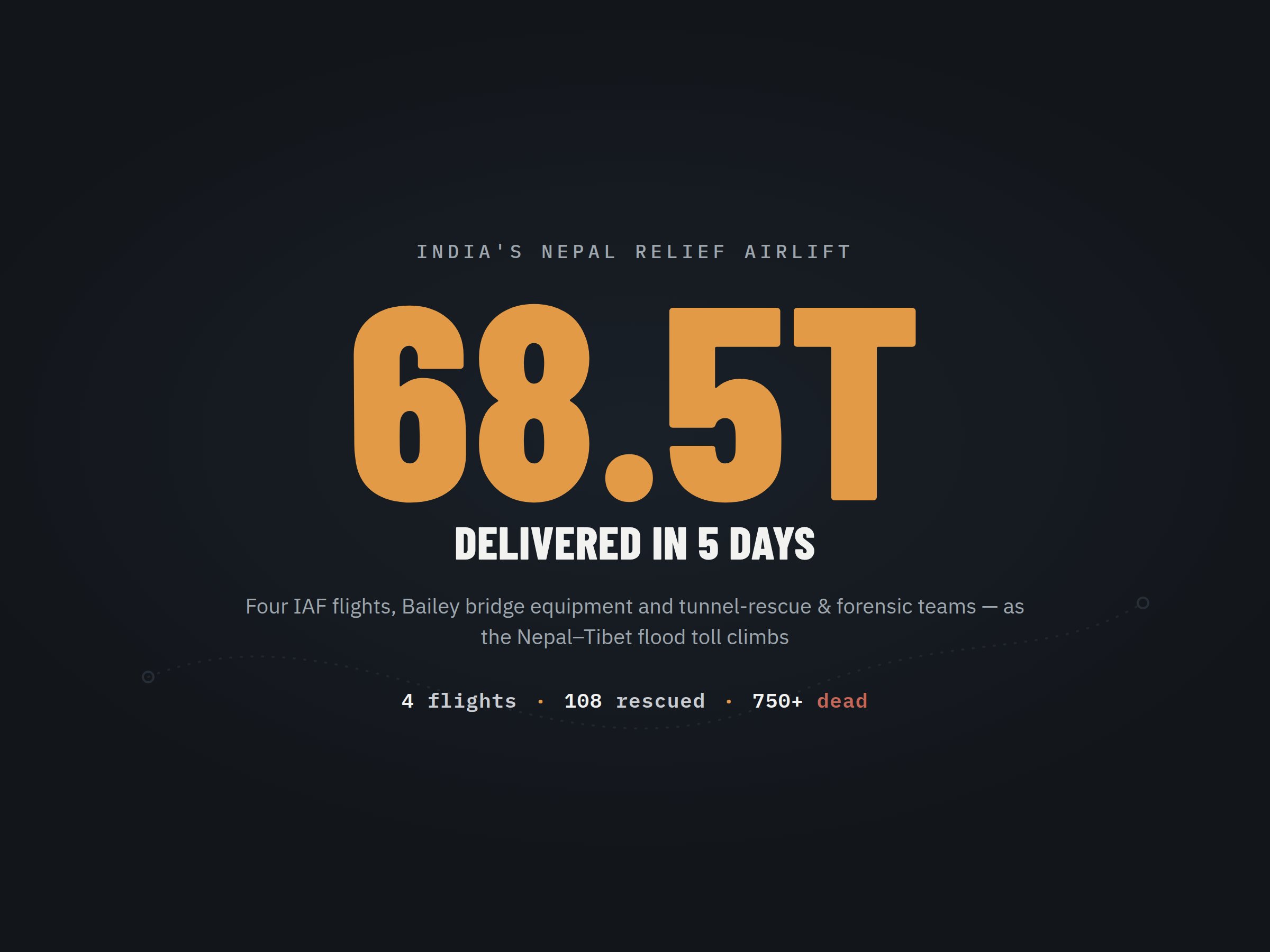
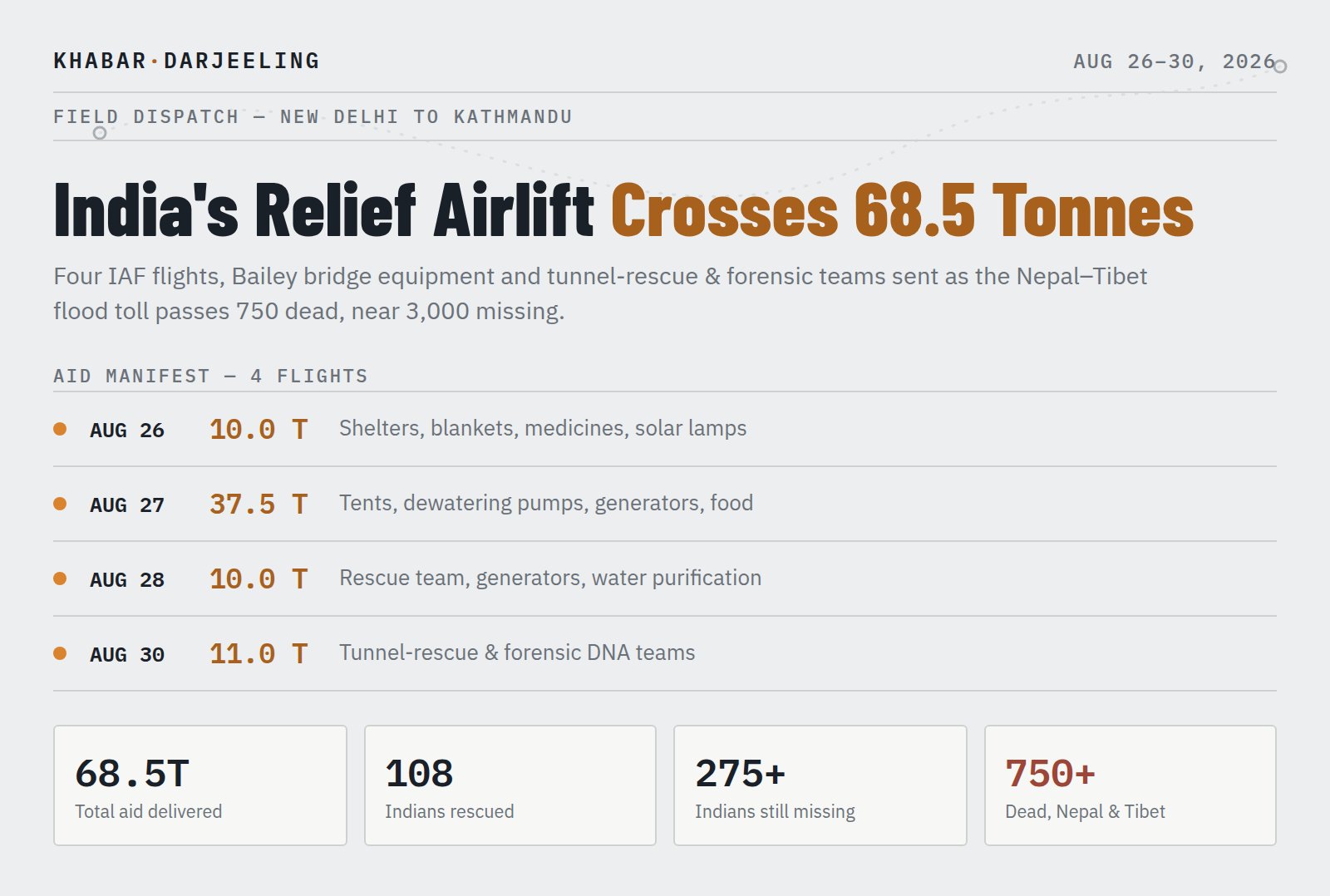
India's four-flight, 68.5-tonne relief airlift to Nepal, Aug 26–30, 2026. Graphic: Khabar Darjeeling
India's Nepal Flood Aid Crosses 68.5 Tonnes as Fourth Relief Flight Lands With Tunnel Rescue and Forensic Teams
India's relief effort for flood-ravaged Nepal has grown into one of its largest cross-border humanitarian operations in years: as of Sunday, August 30, four Indian Air Force flights have
The Aid Timeline
| Flight | Date | Tonnage | Key Contents |
|---|---|---|---|
| 1st | Aug 26 | 10 tonnes | Temporary shelters, blankets, hygiene kits, solar lamps, emergency medicines |
| 2nd | Aug 27 | 37.5 tonnes | Tents, blankets, hygiene kits, solar lamps, dewatering pumps, kitchen sets, generators, medicines, food |
| 3rd | Aug 28 | 10 tonnes | Portable generators, dignity kits, food packets, water purification tablets, plus an 11-member doctor/paramedic/tunnel-reconnaissance team |
| 4th | Aug 30 | 11 tonnes | Blankets, sleeping bags, tarpaulins, plastic sheets, hygiene kits, tunnel search-and-rescue equipment, forensic DNA analysis kits |
| Total | 68.5 tonnes |
Bridges, Tunnels and Forensic Support
Nepal's flood damage wasn't limited to loss of life — it also severed road links across Rasuwa, Nuwakot and Dhading, cutting off entire communities. On the bridges: 16 trucks carrying equipment for a 230-foot single-lane modular steel Bailey bridge have already arrived, with equipment for seven more bridges expected shortly and installation teams to follow. Nepal has asked India and China jointly to help build 42 Bailey bridges in total to restore connectivity.
On the ground since Friday: an 11-member Indian technical team of doctors, paramedics and tunnel engineers has been conducting reconnaissance at hydropower tunnels in the Trishuli area, working alongside an 82-member joint Nepali security force — Nepal Army, Armed Police Force and Nepal Police personnel — who have been clearing debris since Friday night.
On identification: India has also sent forensic experts and DNA-analysis equipment to help Nepali authorities identify recovered remains, a grim but necessary part of the response given how many bodies are still being recovered days after the disaster.
India's External Affairs Ministry described its posture as flexible rather than prescriptive:
"We have given them a range of support offers; they are evaluating it. Whatever they feel is appropriate, they will pick up for their needs."
Indian Nationals: Rescued, Missing, Still Crossing
The human dimension of India's response centers on its own citizens caught in the disaster zone. As of the latest count, 108 Indian nationals have been rescued, including 50 who had previously been untraceable, while more than 275 remain missing — a figure the government describes as including 128 persons of Indian origin. Separately, 598 Indian nationals have safely crossed from China into Nepal over the preceding two days, and roughly 900 more remain stranded on the Chinese side of the border, though authorities say they are safe and in contact with Indian missions.
India's Ministry of External Affairs has stood up a round-the-clock control room in Delhi, with emergency helplines running out of its missions in both Kathmandu and Beijing to track missing persons and coordinate evacuations. The ministry is also coordinating the safe transit home of Kailash Manasarovar pilgrims who were passing through the affected border region when the flood struck.
External Affairs Minister S. Jaishankar framed the response in blunt terms of solidarity:
"Our thoughts are with the bereaved families and all those affected. In face of this challenge, India stands with Nepal and its people."
The Bigger Picture
India's aid is arriving into a disaster whose scale has kept growing since it began. The flood struck the Bhote Koshi and Trishuli river systems on the morning of August 26, triggered by a glacier collapse near the Nepal-Tibet border. Nepal's confirmed death toll and China's combined have now passed 750, with rescue and relief agencies putting the missing count at close to 3,000 across both countries — figures that have risen sharply day by day as search teams reach areas that were cut off by damaged roads and destroyed bridges. Rescue operations are continuing under difficult conditions, with rain and the risk of secondary flooding from debris-blocked stretches of river adding pressure on teams still working through the disaster zone more than four days on.
*This is a developing story. Casualty, missing-person and aid figures are being updated by Indian, Nepali and Chinese authorities as verification continues, and this report reflects the most recent confirmed figures as of the evening of August 30, 2026 (IST).*
Sources: ThePrint, ANI News, The Tribune, Organiser, France 24, The Irish Times, The Daily Star, CBS News, The Federal, NBC News, ABC News
Have a tip on this story?
WhatsApp Khabar Darjeeling at our channel or email nowanad@gmail.com. Your identity will be protected.
© 2026 Khabar Darjeeling
By Adhar limbu
All rights reserved. Content may not be reproduced without permission.