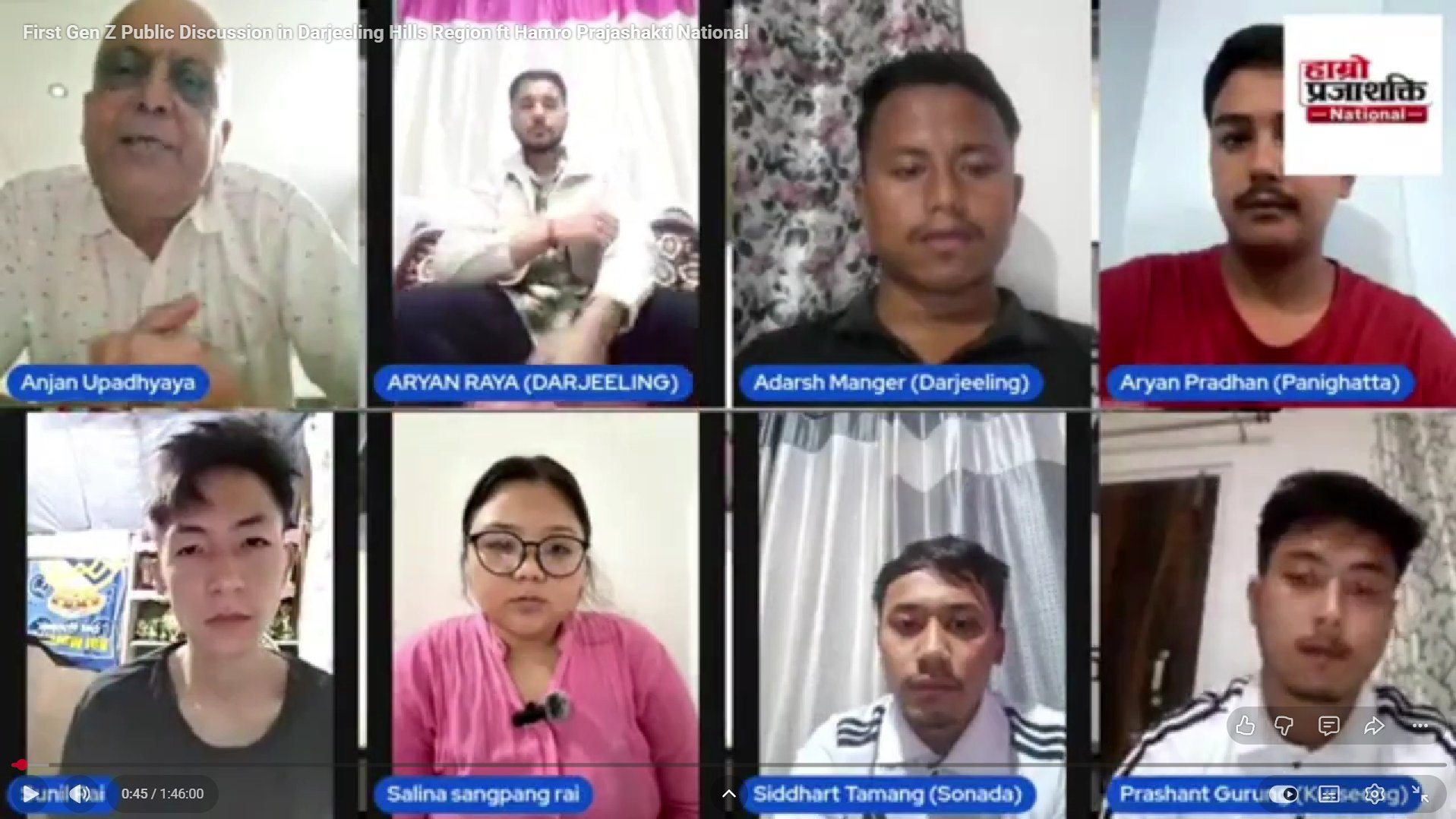
"From the Hamro Prajashakti panel on Darjeeling's Gorkhaland demand, August 24, 2026. (GorkhaTV)"
"Gorkhaland Is Not a Flipkart Delivery": Darjeeling's Gen Z Puts Amit Shah's Promise on Trial
A 1-hour-46-minute panel hosted by Hamro Prajashakti and streamed also on GorkhaTV pushed past slogans into a genuinely sharp debate over what a "permanent political solution" should actually mean
Two days after the Centre reconfirmed its committee on a "permanent political solution" for the Gorkha demand, seven young panelists from across the hills spent nearly two hours testing that phrase against 119 years of unmet promises — and against each other's read of what comes next.
The discussion, moderated by Anjan Upadhyaya for Hamro Prajashakti National and streamed live via the Hamro Prajashakti YouTube channel, brought together Prashant Gurung, Salina Sangpang Rai, Adarsh Manger and Aryan Raya (all Darjeeling), Aryan Pradhan (Panighatta), Sunil Rai, and Siddhart Tamang (Sonada). What emerged was less a rally and more a genuine argument — over strategy, over which political parties to trust, and over whether the word "Gorkhaland" is being deliberately avoided by the very people negotiating it.
The Word Not in the Room
The panel's sharpest observation came from Siddhart Tamang, who pointed out that the language coming out of Delhi and Kolkata — "permanent political solution," "PPS," "constitutional session," "identity" — carefully avoids the one word that actually matters. "Gorkhaland" itself, he said, has not been uttered by a single leader on any official platform, and panelists openly debated what that omission signals about the direction talks are heading.
That suspicion ran through the discussion. Prashant Gurung and others referenced Chief Minister Suvendu Adhikari's opening remarks at the August 22 meeting — that Bengal "will not be divided" — alongside reports that GJM's Bimal Gurung had separately met the BJP state president, with friendly photos circulating on social media. Several panelists were openly skeptical that either signals real movement, noting that any settlement ultimately runs through Kolkata's political arithmetic as much as Delhi's.
What "Solution" Might Mean Instead of Statehood
Much of the debate turned on alternatives to full statehood that panelists worried could be substituted in: Union Territory status, or Sixth Schedule protections, with or without a legislative council. Salina Sangpang Rai argued these options are not interchangeable and that youth need to understand the "merits and demerits" of each before any of it is presented as a win — while also arguing that Darjeeling's demand doesn't map cleanly onto the Sixth Schedule framework used for tribal autonomous councils, since the hills' population is roughly 97% non-tribal. Sunil Rai raised a specific warning drawn from the Bodoland Territorial Region's experience: funding that flowed reliably under an earlier autonomous council arrangement reportedly dried up after Bodoland's status changed, a precedent he argued Darjeeling should study closely before accepting any similar structure.
A Generation Weighing Whether to Trust the Streets or the Feed
A recurring thread was why Darjeeling's youth haven't mobilized online the way Gen Z movements elsewhere have. Siddhart Tamang noted that Delhi Police had reportedly been directed to handle Gen Z protesters "with a soft hand" following the nationwide protests over exam and education-policy failures earlier this year — protests that forced real concessions — and asked why hill youth haven't generated similar pressure through reels and social campaigns. Prashant Gurung pushed back sharply on the comparison itself: that was a nationwide movement, he argued, while Darjeeling's is regional, and the scale isn't comparable — though he was just as blunt that social media alone won't finish the job.
Gorkhaland doesn't arrive by home delivery.
Pressure, he argued, has to eventually move from comments and reels into people actually showing up.
Aryan Raya added a generational-trauma dimension: youth who grew up on stories of the violence and lives lost in the late-1980s and 2017 movements, without the demand ever being fulfilled, are left wary of investing trust in leadership again — one reason, he argued, independent youth politics barely exists in the hills, since visibly political youth tend to get absorbed into existing party structures and lose credibility with their peers.
Widening the Map
Prashant Gurung and Aryan Pradhan both argued for taking the campaign beyond Darjeeling and beyond Nepali-language audiences — running parts of it in Hindi and English so the rest of India understands why the demand exists at all, and treating Gorkha communities in Assam, Arunachal Pradesh, Nagaland, Sikkim, and elsewhere as equal stakeholders rather than an afterthought. Aryan Pradhan pointed to the successful campaign for Nepali language's inclusion in the Constitution's Eighth Schedule as a precedent: that campaign, he noted, succeeded because it approached every political party rather than depending on one — an approach he argued the current push should also take, including formally writing to opposition leaders. Several panelists said letters had already gone out to the Leader of the Opposition on that basis.
What's Still Unresolved
The panel closed without consensus on tactics — street mobilization versus digital pressure, single-party reliance versus a multi-party campaign — but with shared ground on two things: that accountability needs to be demanded of hill leadership regardless of which party holds it, and that the panel discussion itself, panelists said more than once, was a rare thing to have happened at all.
Have a tip on this story?
WhatsApp Khabar Darjeeling at our channel or email nowanad@gmail.com. Your identity will be protected.
© 2026 Khabar Darjeeling
By Adhar limbu
All rights reserved. Content may not be reproduced without permission.